There is an undeniable allure to exploring the United Kingdom behind the wheel of a rental car. Renting a vehicle grants you the freedom to curate your own itineraries, whether that entails winding through the picturesque villages of the Cotswolds, taking a coastal drive along the North Coast 500 in the Scottish Highlands, or exploring the rugged landscapes of Snowdonia in Wales.
Due to recent global fuel price fluctuations, many travellers often express concern about whether renting a car in the UK is still a financially viable option. However, when you evaluate it carefully, car rentals remain exceptionally cost-effective, especially for families or groups, for whom individual train and long-distance bus fares quickly add up.
Furthermore, modern rental fleets across Great Britain feature highly fuel-efficient compact hatchbacks and modern hybrids that make managing road trip expenses easier than ever. Understanding station logistics, payment methods, and money-saving strategies will ensure your UK driving experience remains seamless, economical, and completely stress-free.

You should always verify the exact fuel type of your rental car before driving to a petrol station, as putting the incorrect fuel into a vehicle causes severe engine damage and incurs substantial charges from rental agencies. Never assume that your vehicle uses petrol simply because it is a standard sedan or hatchback, as diesel cars remain common across the United Kingdom.
Most modern rental cars have a sticker clearly affixed inside the fuel flap indicating the required fuel type, such as "Unleaded Petrol / E10" or "Diesel / B7". Rental agencies also frequently attach a plastic tag directly to the car keys specifying the required fuel type. If these manual labels are not available, you can check the dashboard near the fuel gauge or your rental agreement, which should explicitly state the fuel specifications.
Before pulling up to a petrol station, you must familiarise yourself with local terminology and fuel labelling. UK petrol stations strictly enforce a colour-coding system for fuel pump handles. Green pump handles always indicate unleaded petrol, whereas black pump handles exclusively specify diesel. Standard unleaded petrol is labelled as E10, which is perfectly suitable for most standard rental vehicles, unless the rental agency specifies otherwise. Diesel fuel is labelled as B7, which is less common in fleets nowadays.
Navigating petrol stations is easy once you understand the standard procedure. Follow these steps to ensure a seamless experience when you stop to fuel up in the United Kingdom:
Drive onto the petrol station and align your vehicle with an available pump, noting which side your fuel filler cap is on. Turn off the engine completely, engage the parking brake, and release the fuel door hatch from inside the cabin.
If using an automated Pay-at-Pump system, insert your credit or debit card into the pump terminal, follow the prompts to enter your PIN or authorise payment, and wait for the screen to instruct you to lift the nozzle. If paying inside the station shop after refuelling, bypass the terminal and proceed straight to dispensing fuel.
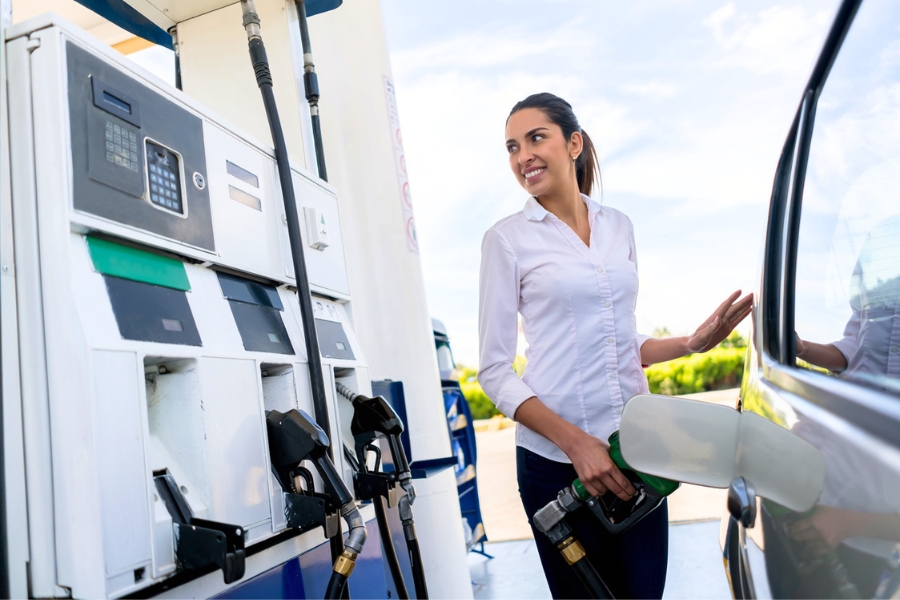
Select the correct fuel handle using the colour coding system. Insert the nozzle fully into the car's fuel neck filler and squeeze the trigger to begin dispensing while keeping an eye on the digital display showing litres and the total cost.
Wait for the nozzle to automatically click shut when the tank is full, replace the nozzle back onto the pump rack, screw the fuel cap back on until it clicks firmly, and close the outer fuel door securely.

Paying for fuel across Great Britain is highly convenient, offering multiple modern payment avenues. Drivers can choose between using automated Pay-at-Pump terminals located directly beside the pumps or walking inside the station shop to pay a cashier. Pay-at-Pump is particularly convenient at unmanned stations or during late hours. These terminals accept major international credit and debit cards, as well as digital mobile wallets. Cash payments are accepted exclusively inside the station shop, so drivers wishing to use physical currency must ensure the shop is open and manned before lifting the nozzle.
When utilising Pay-at-Pump service, you should be fully aware of temporary banking holds. To verify that a card possesses sufficient funds prior to dispensing fuel, automated pumps temporarily reserve a pre-authorised amount. Once the actual transaction is completed, the system updates the charge to reflect the precise cost of the fuel dispensed, and the temporary hold is released. While British banks process this update almost instantly, international bank accounts may occasionally take a few business days to reflect the cleared hold, which you should factor into your travel budgets. Always request and retain a printed physical receipt from the pump or cashier, as this serves as definitive evidence of the time, location, and volume of fuel added.
Pick a Fuel-Efficient Rental Car: Opting for a compact sedan or modern hybrid naturally yields much higher fuel efficiency. Choosing these smaller models over large SUVs or 4x4 vehicles will significantly reduce the amount of fuel you consume on winding rural roads.
Drive Smoothly at Local Speed: Practising smooth acceleration and avoiding abrupt braking keeps your engine operating within its most economical performance range. Staying strictly within national speed limits on dual carriageways and motorways further prevents unnecessary fuel waste.
Keep Your Vehicle’s Load Light: Extra weight in the boot forces the vehicle's engine to work considerably harder. Clearing out unnecessary heavy items and keeping windows rolled up at high speeds will keep your fuel consumption down.
Refuel at Supermarket Stations: Major supermarket chains consistently offer the lowest fuel prices across the United Kingdom. Buying fuel at these store locations will save you several pence per litre compared to independent branded stations.
Avoid Major Motorway Stations: Stations positioned directly along major motorways charge premium rates that are noticeably higher than off-highway alternatives. Taking a brief detour off the nearest motorway junction into a local town will deliver substantial savings on a full tank.

Are petrol stations across the UK often self-service? Almost all petrol stations throughout the United Kingdom operate as self-service locations. Drivers are expected to park at the pump, choose their fuel handle, and pay independently without assistance from an attendant.
How does the colour-coding system work at pumps? In the UK, green handles strictly designate unleaded petrol, while black handles exclusively indicate diesel fuel. Because this system is the opposite of other countries, international drivers should always double-check the written label on the nozzle before dispensing.
Is fuel sold by gallons or litres at UK petrol stations? Fuel is sold and priced strictly by the litre at all petrol stations in the UK. However, road distances are displayed in miles, and vehicle efficiency is calculated in miles per gallon, so remember that one Imperial gallon equals roughly 4.54 litres.
Can I use international cards or cash to pay for fuel? International credit and debit cards are accepted at almost all petrol stations. Cash is also accepted, though you must pay the cashier inside the station shop rather than at an automated Pay-at-Pump terminal.
What should I do if I accidentally put the wrong fuel? Do not start the engine under any circumstances, as turning the key will circulate the incorrect fuel and cause severe mechanical damage. Keep the engine switched off and immediately call your rental agency’s roadside assistance hotline to arrange a fuel drain.
How near to the drop-off area should I refuel my car? You should fill the tank at a petrol station within a five- to ten-mile radius of your rental drop-off location to ensure the gauge reads full. Be sure to keep your itemised physical or digital receipt as proof of the time and location of your final top-up.
Renting a car in the United Kingdom opens up a world of extraordinary travel opportunities, granting you seamless access to historic landmarks, remote villages, breathtaking national parks, and secluded coastal viewpoints that local public transport simply cannot reach.
Although global fuel costs require thoughtful planning, knowing the refuelling process ensures that your road trip remains affordable and efficient. By understanding the colour-coding system, selecting fuel-efficient rental cars, and choosing supermarket stations over motorway service areas, you can manage your journey with complete confidence.
Do not let concerns about navigating petrol stations hold you back from experiencing the adventure of a lifetime. Armed with these simple strategies, you are ready to effortlessly fuel up and hit the open road. So, create your bespoke route across the British countryside, book your ideal rental car, and embark on an unforgettable road trip across the United Kingdom.