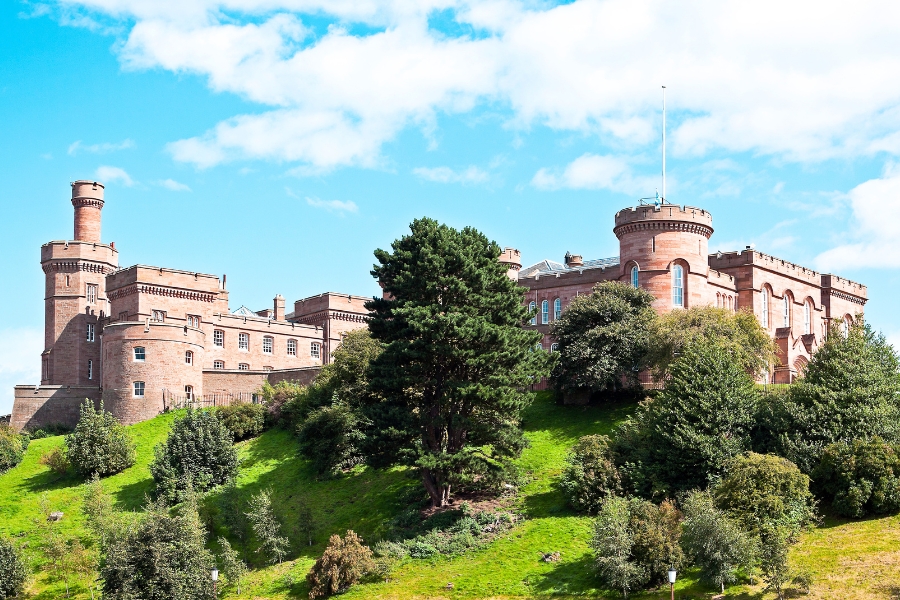
The Scottish Highlands possess an untamed, ancient allure that has captivated travellers for centuries. Characterised by towering mountain peaks, mirror-like lochs, and historic ruined castles, this region offers some of the most dramatic landscapes in the United Kingdom. However, fully experiencing the magic of the region requires the freedom of four wheels.
Driving in the Scottish Highlands is essential for anyone wishing to venture beyond the standard tourist trail. Public transport in northern Scotland is largely tailored to local commuter corridors, leaving vast swathes of remote wilderness inaccessible to bus or train networks.
Renting a car gives you the independence to explore remote trailheads, pause at unscheduled coastal viewpoints, and discover secluded bays. Crucially, having your own vehicle allows you to adapt your daily itinerary around Scotland’s famously unpredictable weather, chasing clear skies across valleys and glens whenever conditions change.

Driving through the North Coast 500 represents the quintessential Scottish road trip. Starting and ending in Inverness, this coastal route leads drivers through a constantly shifting tapestry of sea cliffs, mountain passes, and isolated beaches. Your journey begins by tracing the east coast past grand monuments before cutting across the wild northern shore. Here, you encounter Smoo Cave near Durness, a magnificent limestone sea cave complete with an internal waterfall fed by a natural sinkhole.
Continuing west along the coast, the route curves south into the rugged territory of Assynt, where the white sands and clear turquoise waters of Achmelvich Beach contrast strikingly with the dark, jagged peaks nearby. Further south on the Applecross peninsula lies the route's most exhilarating challenge: the Bealach na Bà. This single-track mountain pass climbs steeply through alpine-style hairpin turns to an elevation of over 2,000 feet, rewarding your efforts with views across the water to Skye.
Renowned as one of the world’s most scenic drives, the A82 road offers an unmatched cross-section of mountain scenery. Running north from the outskirts of Glasgow up to Inverness, this main artery cuts directly through the central Highlands. The route's definitive highlight is the passage through Glen Coe, a deep volcanic valley framed by the rock formations of the Three Sisters mountains.
The road weaves past the soaring peak of Buachaille Etive Mòr, known for its sharp, triangle shape and as one of the most photographed mountains in Scotland. Pushing further north towards Fort William, the road runs beneath Ben Nevis before revealing views of the famous Glenfinnan Viaduct, where historic steam trains cross the valley floor. The final leg of the A82 hugs the long, dark shore of Loch Ness, leading motorists straight to the 13th-century ruins of Urquhart Castle, which sit dramatically on a promontory jutting out into the water.
Extending the adventure onto the western islands, the route across the A87 highway and around the Trotternish Loop on the Isle of Skye displays some of the most surreal geology in Europe. Your journey begins on the mainland, where the A87 leads to Eilean Donan Castle, a picture-perfect fortress resting at the meeting point of three sea lochs just before you cross the Skye Bridge.
Once on the island, following the A855 northern loop brings you face-to-face with the Trotternish Ridge. This northern peninsula was formed by a series of ancient landslips, resulting in dramatic features like the Old Man of Storr, a massive, standalone pinnacle of rock visible for miles.
Driving further along the loop reveals the Quiraing, an otherworldly plateau of high cliffs and steep bluffs overlooking the ocean. The route concludes on the island's far western edge at Neist Point Lighthouse, where a single road leads to dramatic cliffs that drop straight into the churning waters of the Minch.

While the major routes offer spectacular scenery, the true soul of the Scottish Highlands is often found in its quieter, less-visited corners. If you are looking to escape the crowds, consider detouring to these under-the-radar locations.
Glen Affric: Often cited as Scotland’s most beautiful glen, this area features ancient Caledonian pine forests and breathtaking walks around Loch Affric. It is a perfect alternative for those who find the busy trails of Glen Coe too crowded.
Glen Lyon: Stretching over 30 miles, this is often called the "longest, loneliest, and loveliest" glen in Highland Perthshire. It is an ideal spot for a quiet driving tour or a reflective walk along the River Lyon.
Plockton: Known as the "Jewel of the Highlands", this tranquil village on the shores of Loch Carron offers palm-lined waterfronts and colourful cottages. It serves as an ideal base for exploring the area without staying in the busier tourist hubs of Skye.
Isle of Raasay: Many visitors head straight to Skye, but catching the short ferry to neighbouring Raasay rewards travellers with a dramatic hike up Dùn Caan, a tasting session at the local distillery, and a peaceful walk around Brochel Castle.
Ardnamurchan Peninsula: Located at the far western edge of the mainland, this remote region is perfect for travellers who seek solitude. You will find black volcanic sands at Sanna Bay and the isolated Ardnamurchan Lighthouse, all accessed via scenic single-track roads.

Navigating the roads across the Scottish Highlands requires specific knowledge, especially when driving in the adjacent islands where conditions differ from mainland highways.
Pack Layers of Clothes: Highland weather can cycle through four seasons in a single afternoon, bringing dense fog, heavy rain, and sunshine in rapid succession. Keep waterproof jackets and warm layers easily accessible in your rental vehicle so you can stay comfortable during spontaneous excursions.
Download Offline Maps: Mobile phone signal drops significantly across deep glens, coastal passes, and remote island tracks. Download offline maps and save your entire driving route to your device before leaving your accommodation so you never lose your way without cellular service.
Explore During the Day: Summer months bring up to 18 hours of continuous daylight, whereas winter conditions dramatically shorten the window for safe sightseeing. Tailor your daily driving distances to the seasonal daylight hours to avoid navigating unfamiliar, narrow roads in total darkness.
Navigate Single-Track Roads: Pull into the passing place on your left or wait on the opposite one on your right when yielding to oncoming drivers or letting faster traffic overtake. Never park inside passing places or use them as scenic photo pull-offs, as keeping these clear is vital for smooth local traffic flow.
Look for Wandering Animals: Much of the Highland countryside remains unfenced, meaning sheep, cattle, and red deer frequently wander onto active roadways. Reduce your speed around blind bends and give animals plenty of space to clear the tarmac safely before proceeding.
Do I need to rent a 4x4 in the Scottish Highlands? No, standard rental cars are fully suitable for navigating the vast majority of the Scottish Highlands. Compact vehicles are often much easier to manoeuvre through tight passing places and along narrow single-track roads.
What are the rules in passing single-track roads? When an oncoming car approaches or a faster vehicle wants to overtake, you should pull into the passing place on your left or wait directly opposite one on your right. Never park in these designated passing areas, and remember to offer a friendly wave.
Can I camp in my car overnight in the Highlands? No, Scotland’s statutory "Right to Roam" applies exclusively to travellers on foot or bicycle, not on vehicles. You are strictly prohibited from parking overnight along roadsides or in passing places, and you must use designated campsites or overnight parking areas instead.
Can I easily find petrol stations in the Highlands? Petrol stations are plentiful in major regional hubs like Inverness or Fort William, but they become increasingly sparse across rural glens and coastal areas. It is recommended to top up your tank whenever you pass an open station before venturing into remote locations.
A road trip through the Scottish Highlands offers an unparalleled blend of natural majesty and rich history. Whether you are navigating the hairpin bends of the North Coast 500, tracing the hauntingly beautiful valley floors of Glen Coe, or catching a ferry to the rugged Atlantic outposts of the Hebrides, having your own vehicle transforms a standard holiday into a true expedition.
Driving gives you the rare privilege of setting your own pace, granting you front-row access to Britain’s most captivating landscapes, from mist-shrouded lochs and ancient ruins to secluded coastal views that remain hidden from travellers who rely on public transport. While the winding single-track roads and unpredictable weather require a strategic approach and a spirit of adventure, the rewards of the journey far outweigh the challenges.
By preparing for the terrain, respecting the local wildlife, and embracing the spontaneous nature of Highland travel, you open the door to a side of Scotland that few visitors ever get to experience. There is no better way to connect with this dramatic corner of the world than from behind the wheel. Rent a car in the United Kingdom today and set off on an unforgettable driving adventure through the heart of the Scottish Highlands.